Wednesday, October 23, 2013

"Four Things I Learned From My Catholic Mother that Have Made Me a Better Jew," a Blog Post on URJ

Hello, friends!

For those who have not yet seen it, I wanted to share a post I wrote that was recently published on the Union for Reform Judaism's (URJ) website. It's entitled "Four Things I Learned From My Catholic Mother that Have Made Me a Better Jew" (though there are a lot more than just four things): http://goo.gl/XDhBqo

Mama Z on the left, me on the right (in Ireland, 2010)

I really appreciate that the URJ, which is my part of Judaism, was willing to publish something I wrote, especially when even some Reform Jews today are not big fans of interfaith marriage.

The piece actually came about when, six months ago, I was browsing the URJ website and saw a type of "question and answer" section where apparently Reform rabbis could answer questions submitted by different people. The question I saw was something to the effect of, "What does Judaism think about interracial marriage?" which seemed like a no-brainer to me, obviously we are fine with interracial marriage. But it was an odd enough question that I decided to look at the answer--and indeed, the rabbi who answered it said that of course, interracial marriage is fine...and then he went off on a small rant about how while interracial marriage is fine, interfaith marriage is not.

For the record, this is not the official ideology of liberal Reform Judaism (though it is for the Conservative and Orthodox movements), since Reform Judaism tries to welcome people in interfaith marriages. I could not let that go unnoticed, especially something so hidden in a completely unrelated section, so I wrote a comment on the post to let people know that I was not okay with it.  

My exact comment on the post was this:

"'Judaism feels' that it is best for the Jewish people when Jews marry other Jews'
Yet again, URJ, I am surprised and saddened that our movement still exhibits these feelings against interfaith marriage. It may not seem like a big deal, but when you are living the Jewish faith and chose Reform Judaism specifically for its supposed 'welcoming' nature towards interfaith couple, more traditionalist sentiments like this hurt every time."

I did not really think anything would come of my comment, but two people from the URJ actually wrote back to me very soon after (including a rabbi) and acknowledged that the answer was not coherent with liberal Judaism. As a result, they took that part of the response down and then invited me to write a blog post for them. Wonderful! Changes will not come about if people do not make a fuss when things need to change.

Unfortunately, just now, I found another something on the URJ website that bothers me: http://www.reformjudaism.org/we-are-adopting-baby-boy-we-had-him-circumcised-must-he-undergo-conversion-ceremony-be-jewish

Basically, the post says that someone who is adopted needs to undergo a conversion ceremony to be Jewish. This is wrong according to our movement's theology. In Reform Judaism, even if you are adopted, as long as one of your parents (the people who raise you) is Jewish, and you are raised in the faith, then you are Jewish.

Since I'm adopted, I've discussed this many times, including during a visit to the Reform rabbinical school, Hebrew Union College - Jewish Institute of Religion, in Manhattan last summer (making sure I would be eligible to attend their school if I wanted to--the answer was a resounding yes). Alas, it would seem that another URJ post does not fit with our theology. Rather than comment this time, I sent along an e-mail, and I expect that I will hear back soon, since I have only had lovely experiences so far with the people at URJ. I will put a follow-up comment on this post about their response when I do.

So make a fuss! Let people know when you disagree! And most of all, stick up for what you know to be true, because it might lead to some exciting things.

Now go out and love one another.

<3,
Allyson

Sunday, October 20, 2013

Remembering the Shoah

Hello friends.

I was fortunate enough this past week to be able to participate in a uniquely Roman event when I attended an event called "Camminata Silenziosa," which translates to "Silent Walk." The reason behind it, like most of my stories, requires some background information.

During World War II, the Nazis eventually made it down to Rome. When they arrived, they demanded that the Jews of Rome (one of the oldest, continuing Jewish communities anywhere, I believe) give them 50 kilos of gold within 36 hours if they didn't want to be carted off to concentration camps to be killed. For any North American or otherwise non-kilo-using countries, this was a completely unreasonable request from the poor Roman community. But, in a great story of interfaith interaction, the non-Jewish Romans also banded together with the Jews and donated their precious gold items--and they raised the entire amount.

But then the Nazis came anyway. On October 16, 1943, over 1000 Jews were deported from Rome to Auschwitz. 16 would return after the war, 15 men and 1 woman. So every year on the anniversary of this horrible event, the deportation of so many Roman Jews, they walk. Walk through the Jewish section of Rome, where there is the second largest synagogue in Europe, and where thousands of Jews were once confined in horrible conditions.

Have you visited the Roman Jewish section? It used to have gates, which would be locked after sundown for 350 years. The Jews were forced to finance the guards standing at these gates. Outside each gate was a church, in an attempt to convert the Jews to Catholicism as they entered or left (many of these still stand, one with Hebrew writing above its doors that was meant to appeal to the Jews). I have now visited the large Tempio Maggiore, an Orthodox synagogue, for services twice and once for a museum tour last week. Both times for services I felt uncomfortable--it's a gorgeous building, but too ornate for my taste (coming from a culture where usually synagogues seem to be pretty plain, with white walls, this one in Rome has so much decoration, which was the result of the finally-emancipated Jews, happy to be able to finally build a large synagogue in Rome, going a bit overboard). But more than that...the women's section is upstairs, behind a black wrought-iron fence. I can barely see or hear anything when I attend. But I do enjoy walking through the Jewish section (where most shops and restaurants are closed from Friday-Saturday night in observance of Shabbat).

So the "Silent Walk" (deservedly in quotation marks...G-d bless the Italians, but the walk was anything but silent) walked from the large synagogue through the (small) Jewish section, and concluded with a short presentation in the synagogue. The point of the walk in the past was to have the 16 survivors walk, but by now most have died from old age, so I believe two men were there from the original group. The group I went with was fortunate enough to briefly meet with the daughter and son-in-law of one of the survivor. Some local Jewish children sang, and the synagogue was packed.

At the Camminata Silenziosa, October 15, 2014. I have never seen so many yamulkes...

All in all, the idea of participating in a Shoah* (Holocaust) remembrance event was very moving. A great deal of being Jewish in the United States today has to do with remembering the horrors of the Holocaust. I mean, from easily age 8 or 9 I was reading books about the horrors of the Holocaust, simply because it was a part of my past, and because I knew the importance of remembering those who had died. "Never forget" is the saying in Jewish communities in the US today. But to be here--to walk the streets, see the places where these atrocities were committed, meet the people who suffered through these times--that was a whole different thing. While we lost a bit of the meaning because it was in Italian (and the acoustics were not great in the synagogue, so even though I understand a great deal of Italian it did not help much), I think just the fact that we stood in solidarity with the group was important. And there were a lot of people there. To think that the number of people there, maybe several hundred, was not even close to the number of Roman Jews killed...it was just incredible. That fact, combined with the fact that the Jewish children singing proved that the Nazis failed to wipe out the Jewish people, will really stick with me for a while.

In an interesting twist of fate, another Roman/Nazi connection came about last week, when the 100-year-old Nazi war criminal Erich Piebke died. Apparently, he was involved in a brutal murder of 335 civilians in caves outside of Rome in 1944.

He had been in hiding for almost 50 years, before he was found and extradited to Italy, where he has been living under house arrest in Rome since the '90s. When he died a little over a week ago, the Roman Catholic Church in Rome said they wouldn't bury his body. Argentina (where his wife is buried) said they wouldn't bury him. Then, when a small, splinter group of the Catholic Church (no longer accepted by the official Church hierarchy, I believe, and one that has been noted for antisemitic-leanings amongst some of its members) in southern Rome agreed to bury him (on October 15, the same day we participated in the Silent Walk), so many protestors showed up that the funeral was not allowed to proceed. On the exact. Same. Day. As the Silent Walk memorial.

Erich Piebke

He went to his grave denying that Jews were killed in gas chambers during the Holocaust.

Something particularly meaningful for me that brought all of this together happened on Wednesday afternoon when I met with a very sweet retired Roman couple, that (I think) I will be teaching English to this year as a type of side-job. When we eventually got onto the topic of what I'm doing in Rome (studying at a super-Catholic university) the question obviously became "Are you Catholic?" After giving that explanation (No, but my Mom is, I'm Jewish like my Dad) they mentioned the situation with Piebke, as well as the memorial of October 16th. I do not think that they are Jewish, so it meant a lot that even non-Jewish Romans were aware of the Jewish happenings in their city. Seems like, whatever its difficult past, maybe Rome is doing pretty well on the interfaith front today.


Never forget.


Now go out and love one another.

<3,
Allyson

*For those who are unaware, "Shoah" is the favored term in the Jewish community for representing the atrocities committed against the Jews during World War II. It is generally interchangeable with the word "Holocaust."

Sunday, September 15, 2013

Ciao for Now, USA

Hello, friends!

Well, the time is officially almost here: on Wednesday, I finally make my journey over to Rome to study interreligious studies for a year at the Pontifical University of St. Thomas Aquinas. The past few weeks have been fairly busy. I spent a lot of time trying to figure out which things absolutely need to come along in my suitcase (Splenda) and which I can probably leave behind (both pairs of my way-too-high high heels). I managed to navigate the less-than-user-friendly Italian consulate system and finally managed to get my "visto" (good through next July). And I've reminded myself numerous times that no matter how nervous I may get in the next few days, I really do remember how to speak Italian fairly well and so won't be completely lost in my new home for the next year.

But what about the things I'm not realizing? I've now been fortunate enough to move to Europe twice (in 2011 for a study abroad semester in Florence, Italy, and in 2012 for an internship with the Welsh Assembly in Wales, UK), so I'm feeling a little bit too calm for my own good. A little too confident in my ability to handle a move across the pond. I've intentionally spent this summer trying to appreciate how much I love the place where I grew up--Long Island, with the beautiful light on the East End when the sun sets, the look of the beach when it's hazy out. I don't think I've fully succeeded. I predict the adrenaline will kick in as soon as I leave my parents behind at security (and immediately remember ten absolutely essential American products I forgot to pack).

Me in the Colosseum in Rome, Italy back in 2011

There are a few things about this move that should really be getting me a little more nervous than I am. The first is that I've never gone away to Europe for this long, a whole year. Sure, I've lived abroad, but always with an end date in mind, and that date only a few months in the future. Which brings up the second new thing for me...I have not purchased a return flight. I mean, I'll be home for Christmas and New Year's for two weeks in December, and I vaguely plan to come stateside for part of July next year, but past that, it's a little up in the air. Some people may know my ideal next step would be to continue on to get my Master's in the UK in interreligious or Judaic studies. If that miraculously works out, what will I end up doing next summer? Working for a Jewish community in Scotland? Helping out at an interfaith organization in London? Bumming around the states?

The third thing that has me a little uncomfortable is the lack of a liberal Jewish community in Rome. As religion has grown more important to me over the past few years, I've realized that living in a place like Rome for a prolonged period of time probably wouldn't be ideal. I loved my college, but living in a place where I did not find my religious community made me realize that in my "adult" life I ideally hope to live in a place with liberal Jews. Which really means some places in the US or the UK. I figure that this course of study in Rome is so important to and fitting for me that I'm willing to forsake my earlier pledge to live near liberal Jews for this year, but it would be so easy to then say that again if something else comes up next year, and then the year after that, and on and on. If it's important enough to me, though, at some point I'll have to make the decision about whether or not I need a liberal Jewish community in my life constantly. I have certainly valued being home this month, because I was able to spend both Rosh Hashanah and Yom Kippur with my family and my home synagogue for the first time in four years. We shall see.

So what do I expect this coming year? I expect to be hit a little bit with culture shock, given my current (unwise) lack of nervousness. I expect to field a lot of questions from other students at my Catholic university, since I will be one of, if not the only, Jewish person in the group (which I am always happy to answer, yet can sometimes be tiring when there's no one else there who can fully understand my perspective). I expect to miss home, family, and friends, as I always do, but also to adopt the sense of independence I so value whenever I live in a city. And I expect to start figuring out what to do with the rest of my life...or at least with the next few years.

So for now, arrivederci! The next time I post, it will be from Rome. It might take me two or three weeks to get settled enough to write, but never fear--I imagine I'll have a lot of comments once I really get entrenched in the city that houses the center of Catholicism. And I'll do my best to avoid too many kitschy Italian phrases in my posts (okay, maybe just a few).

Now go out and love one another.

<3,
Allyson


Wednesday, September 4, 2013

Intentionality in a Less-Religious World

Hello, friends.

What governs your daily actions? How do you decide that you will attend church every Sunday, for example? Or decide if you're going to use birth control? Or abstain completely from eating meat? What guides your actions?

I have been thinking lately about "intentionality," by which I mean people doing things purposefully, making decisions about their daily actions based upon a guiding sense of principles that are pre-determined by them (as opposed to just going with whatever they are feeling in the moment). Now, these principles can be religious (for example, "I am an Orthodox Jew so I will not use technology on Saturdays") or they can be secular (for example, "I will spend time meditating once a week on ways to help the less fortunate"). But sometimes I wonder how intentionality forms for those who might not very strictly follow a religious doctrine (I'm including myself in here).

In today's technological world, we become used to having access to almost anything, right away. Obscure pieces of knowledge can be found with just a few clicks on the internet, almost any TV show or movie can be located online, Skype/text allows us to communicate with distant friends without a second thought. But what does this instantaneous-results culture do to our relationships and morals? What happened to intentionality? In relationships, is just writing the token "happy birthday!" on someone's Facebook wall once a year enough, when the only reason we know it's someone's birthday is because the website reminded us? Or shooting out a text once every few months just to say "hey"? There are certainly some relationships that can function on this, but I worry about whether as a culture we are moving away from commitment. From saying, "It is a value for me to purposefully call my friend/grandma/favorite professor on the first of every month."

Religions clearly involve a level of intentionality. For example, we intentionally went to synagogue when I was growing up on Yom Kippur every year. It did not matter that we only went to temple for service that one day, but we did it. My father and I also fasted all day, then had bagels for dinner (a typical Yom Kippur meal to break the fast). We did it with purpose. Other religions have similar mantras that guide them: for example, some Catholics might choose to not use birth control because of the theology of their religion. It is a very real-life decision, based on a guiding sense of principles that a person adopts before they are faced with the situation. But what about outside of religion? I don't only mean atheists or agnostics, I mean also questions about life that might fall outside of the specifics of religion.

I think there's value in trying to adopt a set of principles in advance. This may be a simple result of the way my mind works (my number one "strength" on the popular self-assessment StrengthsQuest, a type of personality test is "futuristic," after all), but I see a lot of good in giving thought to things in advance, and trying to live my life intentionally. Whether that's as simple as making sure I reach out to my close friends one a regular basis, or making a resolution (as I did in January) to try to do at least one Jewish-related activity a month.

The most recent examples I have of intentionality in my own life involve two healthy habits I've adopted for myself: giving up diet soda (a former vice of mine) ten days ago, and trying to eat more vegetarian meals. These are small things to do, but nonetheless difficult for me while making some kind of small impact. Diet soda is not healthy, and eating less meat is good for the environment. So even though these new decisions may not hold very long, the idea of not only dealing with life as it comes but also trying to take control of my actions, is important.

Is intentionality important to you? I know this post is a bit heady and theoretical, but I'd be interested to hear your thoughts on intentionality in the comments below.

For now I will leave you with "Shanah tova," a Hebrew wish for a good new year. Tonight is Rosh Hashanah, the Jewish new year, when most Jewish families celebrate with nice family dinners and apples dipped in honey (for a sweet new year). So maybe join me in making a Jewish New Year's resolution to live your life more intentionally--whether that means giving up something you know is not good for you, or deciding to put aside the texting for one day and calling a friend who lives far away.

Now go out and love one another. And Happy New Year to all!

<3,
Allyson

---

If you're new to the blog, don't forget you can add your e-mail address into the box at the top left and you'll receive an e-mail whenever a new post goes up.

Sunday, August 18, 2013

Living the Interfaith Life

Hello, friends.

This past week was one of those weeks that seem to just happen to me, where I have a ton of religious experiences that come from all over the religious spectrum. But I love it! So I figured I would just give a quick update on all of the goings-on in my life right now.

My religiously diverse week started last Sunday, the first day of the Interfaith Youth Core (IFYC) New York Interfaith Leadership Institute (ILI). What that looooong series of titles really means is that I managed to secure a spot at an interfaith conference geared at college students that happened to be hosted at NYU (where I worked last summer).

Now, I've mentioned the IFYC in posts past, but they bear another shout-out. The IFYC is a national organization that uses a grassroots approach to spread awareness of interfaith relations on college campuses. ILI's, like the one I attended, seek to bring together college students and professors who are involved in interfaith work in order to receive training in proper ways to engage people in interfaith relations, and to share best practices from their schools. Since I have already graduated from college, the conference did not always apply to me--free time to "discuss new event ideas with our school delegation" did not really make sense in my case--but I did meet some really interesting people.

For example, I met four individuals who belong to the Church of Jesus Christ of Latter-Day Saints (aka Mormons). How cool is that?! I imagine there are Mormons on Long Island, but I somehow have never met anyone who identifies as such. We had a good time asking mutual questions about faith, and I learned a whole bunch, including that Mormons generally abstain from drinking alcohol, abstain from drinking coffee or tea (because of the addictive nature of caffeine), and wear a special type of undergarment almost all of the time. So interesting! Other than those few things, along with the fact that they have interestingly large families (even though birth control is not actually forbidden) and that many of the young people go on missions for two years to purposely try to convert people to their religion, they seemed very similar to most people I know.

At the conference, one of my favorite activities was something termed "Speed Faithing." Basically, we could choose to attend three, very quick, information sessions on different religions, during which time there was a ten minute presentation on the religion followed by a ten minute question and answer session. I went to Jainism, Islam, and Hinduism. All very interesting! I did not know that Jains are vegetarian and try not to harm any living creatures, like spiders (okay, I knew nothing about Jainism before the session, let's be honest). Another thing I really liked about Jainism is a belief in the religion that they do not claim to have the ultimate truth, it's kind of an acknowledgment of humility, that they try to do the best they can, but that doesn't mean their religion is definitely the only right one. I appreciated that, especially in such an interfaith setting.

We also participated in some interesting learning activities in our smaller break-out groups, such as acting out scenarios of difficult interfaith discussions we might face. Our room of participants was actually very small, so we had a tight group of people that really bonded and learned from each other. Oh, and we had some fun, too...

Just for the record, the Catholic gentleman lying on the floor is a priest. Meanwhile, I was trying very hard not to look too awkward lying on the floor [cue big smile].

The conference lasted Sunday-Tuesday.

In the middle of all that, on Monday night, I attended a wonderful reunion of participants from the Jewish internship program I did last summer (CLIP). It was truly excellent to catch up with some people, see how people had changed (or not) in their faith practice, hear about trips abroad, and just have a nice time with people who know a lot about me from our very deep discussions last summer. After the very amusing happy hour, I wandered around Manhattan with one of my good Jewish friends from the group for a few hours late into the night, discussing/debating religion and Judaism. Even as I write that I realize that it sounds crazy, but that is actually what we usually end up doing, and we always have a great discussion. This one in particular involved analyzing my own religious practice, thinking about other faiths, and the ethics for Jewish people of entering a church.

Then today, our family attended mass at the local Catholic Church. This particular church visit was driven by my Jewish father and I (as my mother so ironically pointed out this morning), because my father knows the priest, Father Vetrano, in a non-religious context and I have met with this priest in the past to discuss interfaith relations. So we went to mass, and when the "greet your neighbor" part came around (a tradition in many Catholic parishes during which time attendees shakes hands and say 'hello' to the people sitting around them) the priest came up to my father and I and said, "Shalom my brother and sister." Then we had lunch with him afterward. All in all, a very interesting morning.

I should also mention the other thing that happened at church today. During the announcements, all of a sudden I heard them say my name--because I will be giving a lecture on interfaith relations at the church on August 27th! This has been in the works for a while. Father Vetrano asked me to speak about my interfaith experiences and my interfaith plans for the future as part of a lecture series they have at the church. I am very thankful to have the opportunity to share my experiences with a larger group of people. If anyone is around Southampton, New York on Tuesday, August 27th at 7 p.m., feel free to come by! Luckily, during the ILI this past week, we talked about how to better craft our personal stories in order to be more effective, so that was a good warm up. For anyone who knows about my story (and if you've read other posts in this blog, you probably have a pretty good idea), the lecture will be a time when I bring everything together, maybe relate a few crazy things that have happened to me, and just generally think about what it all means for me and for everyone else going forward.

I'm in a church bulletin! I'm in a church bulletin!

I hope some of you took my challenge from the last post seriously (to attend another faith's religious service), and if not, give it a shot this coming week. I know that soon many people will be getting back to school or work and real life, so now would be a good time to try out something new. You could always come to my lecture! If you've never been in a church, that could count for fulfilling the challenge. ;)

Now go out and love one another.

<3,
Allyson

Friday, August 9, 2013

Interfaith Marriage in America Today

Hello, friends.

Guess what?! One of my college roommates is getting married. *commences celebration* I was so excited to hear her news, and I am still so incredibly excited (we had an hour-long discussion about seating arrangements not so long ago...), and you will all just have to forgive my excitement, as she is one of my first friends to get engaged. I'm thrilled! And guess what the kicker is...Ready for it? She's entering into an interfaith marriage.

As I have mentioned before, interfaith marriage/family is something I was blessed to experience growing up. With a Catholic mother and a Jewish father, I had the best of both worlds: we celebrated Christmas and Chanukah, Easter and Passover, learned from one another's traditions, and all in all just made it work. But since entering the "interfaith" world more widely, talking about these issues more purposefully and with intentionality, I've learned that not all interfaith marriages work out so smoothly as my parents' has (they're celebrating their 25th anniversary this year!). But why? How? What? Not everyone smoothly transitions into a life involving sometimes conflicting faith beliefs and traditions? (That last one was sarcastic.)

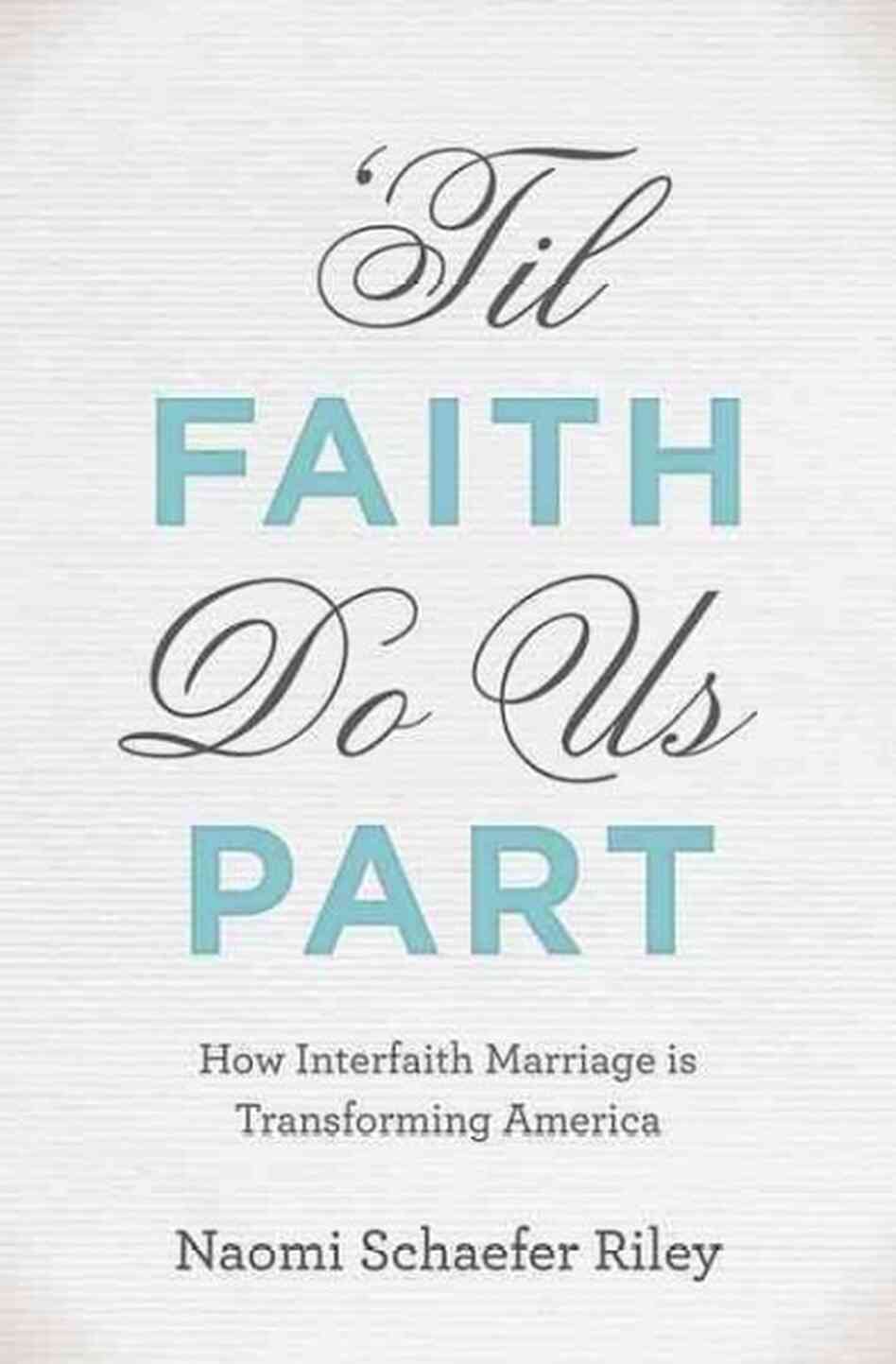
So I was very excited to learn more about interfaith marriages when, a few weeks ago, a good friend of mine recommended I read a new book, 'Til Faith Do Us Part, by Naomi Schaefer Riley, a woman who herself entered into an interfaith marriage. It only just came out in 2013 and it takes an in-depth look at the rise in interfaith marriage in America, both statistically through a study the author did and through stories about specific families.


Let's just say, I finished the book in about a day (though I've kept it checked out of the library waaaay past its due date...oops!). Many people might have found the large number of statistics a bit dull, but I devoured most of them, and really want to try to remember as much as possible from this book for use in my studies in Rome and beyond.

I was a bit disheartened by the somewhat negative tone of the much of the book. Now, the (Jewish) author clearly knows that interfaith marriage can succeed--based on her marriage to a man raised as a Jehovah's Witness (who stopped practicing). But her words seem to put a lot of negative spin on the issues, from the very first issues arising about planning the wedding (one clergy member, two, or a justice of the peace?) to choosing the religion of children (one, both, or none?) and death practices. Even the title itself implies that divisiveness is the order of the day in interfaith relationships, rather than compromise and a desire to learn. I certainly do appreciate a lot of what she said: after reading her book, I see that interfaith can clearly pose challenges. Some such marriages end in divorce, or lead to both members moving away from religion, which may result from the marriage specifically or just arise from individual decisions.

But there are so many things to celebrate in an interfaith families, things that are difficult to experience in as real depth in a same-faith family. A living, breathing appreciation of diversity. A deep knowledge of another faith (remember, I was accepted to study at a Catholic University in Rome, for which an advanced knowledge of Catholic theology was required, something helped by knowing about my mother's faith for my whole life). The ability to understand that no one has to be "right" in matters of faith, that we can all be "right" in different ways (which brings to mind the title of a book You Don't Have to be Wrong for Me to be Right, by Brad Hirschfield, a book I have not read but love the title). Here are some of what I though were the most interesting bits:

  • "About 20% of couples married before the 1960s were interfaith matches. Of couples married in the past decade, 45 percent were." p. 6
  • "One woman I spoke to, who was brought up Catholic, recalls her thoughts on dating when she went off to college: ‘To limit yourself to only people of your own religion seemed bigoted…There is a whole world of people that I don’t know.’ To write them off as potential partners before she even met them ‘seemed rude.’ The language is revealing. It’s as if our society’s institutional rules about hiring an employee or admitting someone to college have morphed into rules for dating.” p. 13
  • "We often tend to imagine interfaith weddings as having two officiants—that both the bride and groom’s traditions are represented equally, perhaps symmetrically. The New York Times wedding announcements do seem to mention a disproportionate number. But weddings with religious leaders from different faiths are rare: only 4 percent of interfaith (and, surprisingly, 2 percent of same-faith) couples employ them. Instead, interfaith couples are much more likely to have used a civil official (43 percent vs. 31 percent for same-faith couples).” p. 62
  • “Americans are mostly reluctant to raise their children in more than one faith…According to my survey, about 80 percent of same-faith couples raised their kids in one faith and about 20 percent raised them in no faith. A plurality of interfaith couples, about 40 percent, agreed to raise their children in one faith. About a third are raising their kids with no faith; and another 20 percent are trying to raise them in both.” p. 99

So for those who choose to seek a partner in the same faith, is there a legitimate, non-discriminatory-seeming way to limit oneself to members of the same religion? Or should that even be a goal in today's multifaith world?

All of these discussions about interfaith marriages get me thinking about my own views on marriage. One of the biggest issues I see with interfaith marriage is the threat of loneliness when wanting to attend religious services. In our family, we sometimes all go together--to temple, to church. But over the past four years in Virginia, and this summer even at home as I start attending more often, if I want to go to services, I often end up going alone. And it's hard. It's tough to be the only person there under 65. It's sad to be alone when everyone else is sitting there with family. And while many people in congregations are usually welcoming, it's just not the same feeling to attend temple alone, maybe because growing up Jewish meant I had a strong community, where I knew a lot of people at temple, and a lot of people knew me. So would I be willing to do that for the rest of my life, if I were to marry someone who was not Jewish? To maybe spend many Friday nights alone in the synagogue, without my significant other?

I don't have that answer yet. But with all of these statistics and ideas swirling around, and as I leave the disappointing college dating scene behind and head out into the wider world, it will definitely be something I keep in the back of my mind.

Now go out and love one another.

<3,
Allyson

Santa DreidelP.S. Can I just point out, the author of this book spent a few pages detailing how much she dislikes the "kitschy" element of mixed-religion cards/paraphernalia (like a Christmas-Chanukah card). I LOVE THESE TYPES OF THINGS mainly because I LOVE Christmas. Send me a card with Santa spinning a dreidel and we may just be friends forever. Because it's less about a specific statement about religion, and more about celebrating that some families are diverse. They sell cute cards here, for anyone who feels a strong desire to bombard me with interfaith love while I'm in Rome...www.mixedblessing.com

Interfaith and the Environment: Quoted in a Zoroastrian Publication

Hello, friends. Last August, I attended the Parliament of the World's Religions in Chicago and was excited to present on a few panels wi...