Hello, friends.
What governs your daily actions? How do you decide that you will attend church every Sunday, for example? Or decide if you're going to use birth control? Or abstain completely from eating meat? What guides your actions?
I have been thinking lately about "intentionality," by which I mean people doing things purposefully, making decisions about their daily actions based upon a guiding sense of principles that are pre-determined by them (as opposed to just going with whatever they are feeling in the moment). Now, these principles can be religious (for example, "I am an Orthodox Jew so I will not use technology on Saturdays") or they can be secular (for example, "I will spend time meditating once a week on ways to help the less fortunate"). But sometimes I wonder how intentionality forms for those who might not very strictly follow a religious doctrine (I'm including myself in here).
In today's technological world, we become used to having access to almost anything, right away. Obscure pieces of knowledge can be found with just a few clicks on the internet, almost any TV show or movie can be located online, Skype/text allows us to communicate with distant friends without a second thought. But what does this instantaneous-results culture do to our relationships and morals? What happened to intentionality? In relationships, is just writing the token "happy birthday!" on someone's Facebook wall once a year enough, when the only reason we know it's someone's birthday is because the website reminded us? Or shooting out a text once every few months just to say "hey"? There are certainly some relationships that can function on this, but I worry about whether as a culture we are moving away from commitment. From saying, "It is a value for me to purposefully call my friend/grandma/favorite professor on the first of every month."
Religions clearly involve a level of intentionality. For example, we intentionally went to synagogue when I was growing up on Yom Kippur every year. It did not matter that we only went to temple for service that one day, but we did it. My father and I also fasted all day, then had bagels for dinner (a typical Yom Kippur meal to break the fast). We did it with purpose. Other religions have similar mantras that guide them: for example, some Catholics might choose to not use birth control because of the theology of their religion. It is a very real-life decision, based on a guiding sense of principles that a person adopts before they are faced with the situation. But what about outside of religion? I don't only mean atheists or agnostics, I mean also questions about life that might fall outside of the specifics of religion.
I think there's value in trying to adopt a set of principles in advance. This may be a simple result of the way my mind works (my number one "strength" on the popular self-assessment StrengthsQuest, a type of personality test is "futuristic," after all), but I see a lot of good in giving thought to things in advance, and trying to live my life intentionally. Whether that's as simple as making sure I reach out to my close friends one a regular basis, or making a resolution (as I did in January) to try to do at least one Jewish-related activity a month.
The most recent examples I have of intentionality in my own life involve two healthy habits I've adopted for myself: giving up diet soda (a former vice of mine) ten days ago, and trying to eat more vegetarian meals. These are small things to do, but nonetheless difficult for me while making some kind of small impact. Diet soda is not healthy, and eating less meat is good for the environment. So even though these new decisions may not hold very long, the idea of not only dealing with life as it comes but also trying to take control of my actions, is important.
Is intentionality important to you? I know this post is a bit heady and theoretical, but I'd be interested to hear your thoughts on intentionality in the comments below.
For now I will leave you with "Shanah tova," a Hebrew wish for a good new year. Tonight is Rosh Hashanah, the Jewish new year, when most Jewish families celebrate with nice family dinners and apples dipped in honey (for a sweet new year). So maybe join me in making a Jewish New Year's resolution to live your life more intentionally--whether that means giving up something you know is not good for you, or deciding to put aside the texting for one day and calling a friend who lives far away.
Now go out and love one another. And Happy New Year to all!
<3,
Allyson
---
If you're new to the blog, don't forget you can add your e-mail address into the box at the top left and you'll receive an e-mail whenever a new post goes up.

Wednesday, September 4, 2013

Sunday, August 18, 2013
Living the Interfaith Life
Hello, friends.
This past week was one of those weeks that seem to just happen to me, where I have a ton of religious experiences that come from all over the religious spectrum. But I love it! So I figured I would just give a quick update on all of the goings-on in my life right now.
My religiously diverse week started last Sunday, the first day of the Interfaith Youth Core (IFYC) New York Interfaith Leadership Institute (ILI). What that looooong series of titles really means is that I managed to secure a spot at an interfaith conference geared at college students that happened to be hosted at NYU (where I worked last summer).
Now, I've mentioned the IFYC in posts past, but they bear another shout-out. The IFYC is a national organization that uses a grassroots approach to spread awareness of interfaith relations on college campuses. ILI's, like the one I attended, seek to bring together college students and professors who are involved in interfaith work in order to receive training in proper ways to engage people in interfaith relations, and to share best practices from their schools. Since I have already graduated from college, the conference did not always apply to me--free time to "discuss new event ideas with our school delegation" did not really make sense in my case--but I did meet some really interesting people.
For example, I met four individuals who belong to the Church of Jesus Christ of Latter-Day Saints (aka Mormons). How cool is that?! I imagine there are Mormons on Long Island, but I somehow have never met anyone who identifies as such. We had a good time asking mutual questions about faith, and I learned a whole bunch, including that Mormons generally abstain from drinking alcohol, abstain from drinking coffee or tea (because of the addictive nature of caffeine), and wear a special type of undergarment almost all of the time. So interesting! Other than those few things, along with the fact that they have interestingly large families (even though birth control is not actually forbidden) and that many of the young people go on missions for two years to purposely try to convert people to their religion, they seemed very similar to most people I know.
At the conference, one of my favorite activities was something termed "Speed Faithing." Basically, we could choose to attend three, very quick, information sessions on different religions, during which time there was a ten minute presentation on the religion followed by a ten minute question and answer session. I went to Jainism, Islam, and Hinduism. All very interesting! I did not know that Jains are vegetarian and try not to harm any living creatures, like spiders (okay, I knew nothing about Jainism before the session, let's be honest). Another thing I really liked about Jainism is a belief in the religion that they do not claim to have the ultimate truth, it's kind of an acknowledgment of humility, that they try to do the best they can, but that doesn't mean their religion is definitely the only right one. I appreciated that, especially in such an interfaith setting.
We also participated in some interesting learning activities in our smaller break-out groups, such as acting out scenarios of difficult interfaith discussions we might face. Our room of participants was actually very small, so we had a tight group of people that really bonded and learned from each other. Oh, and we had some fun, too...

Just for the record, the Catholic gentleman lying on the floor is a priest. Meanwhile, I was trying very hard not to look too awkward lying on the floor [cue big smile].
The conference lasted Sunday-Tuesday.
In the middle of all that, on Monday night, I attended a wonderful reunion of participants from the Jewish internship program I did last summer (CLIP). It was truly excellent to catch up with some people, see how people had changed (or not) in their faith practice, hear about trips abroad, and just have a nice time with people who know a lot about me from our very deep discussions last summer. After the very amusing happy hour, I wandered around Manhattan with one of my good Jewish friends from the group for a few hours late into the night, discussing/debating religion and Judaism. Even as I write that I realize that it sounds crazy, but that is actually what we usually end up doing, and we always have a great discussion. This one in particular involved analyzing my own religious practice, thinking about other faiths, and the ethics for Jewish people of entering a church.
Then today, our family attended mass at the local Catholic Church. This particular church visit was driven by my Jewish father and I (as my mother so ironically pointed out this morning), because my father knows the priest, Father Vetrano, in a non-religious context and I have met with this priest in the past to discuss interfaith relations. So we went to mass, and when the "greet your neighbor" part came around (a tradition in many Catholic parishes during which time attendees shakes hands and say 'hello' to the people sitting around them) the priest came up to my father and I and said, "Shalom my brother and sister." Then we had lunch with him afterward. All in all, a very interesting morning.
I should also mention the other thing that happened at church today. During the announcements, all of a sudden I heard them say my name--because I will be giving a lecture on interfaith relations at the church on August 27th! This has been in the works for a while. Father Vetrano asked me to speak about my interfaith experiences and my interfaith plans for the future as part of a lecture series they have at the church. I am very thankful to have the opportunity to share my experiences with a larger group of people. If anyone is around Southampton, New York on Tuesday, August 27th at 7 p.m., feel free to come by! Luckily, during the ILI this past week, we talked about how to better
craft our personal stories in order to be more effective, so that was a
good warm up. For anyone who knows about my story (and if you've read other posts in this blog, you probably have a pretty good idea), the lecture will be a time when I bring everything together, maybe relate a few crazy things that have happened to me, and just generally think about what it all means for me and for everyone else going forward.

I'm in a church bulletin! I'm in a church bulletin!
I hope some of you took my challenge from the last post seriously (to attend another faith's religious service), and if not, give it a shot this coming week. I know that soon many people will be getting back to school or work and real life, so now would be a good time to try out something new. You could always come to my lecture! If you've never been in a church, that could count for fulfilling the challenge. ;)
Now go out and love one another.
<3,
Allyson
Friday, August 9, 2013
Interfaith Marriage in America Today
Guess what?! One of my college roommates is getting married. *commences celebration* I was so excited to hear her news, and I am still so incredibly excited (we had an hour-long discussion about seating arrangements not so long ago...), and you will all just have to forgive my excitement, as she is one of my first friends to get engaged. I'm thrilled! And guess what the kicker is...Ready for it? She's entering into an interfaith marriage.
As I have mentioned before, interfaith marriage/family is something I was blessed to experience growing up. With a Catholic mother and a Jewish father, I had the best of both worlds: we celebrated Christmas and Chanukah, Easter and Passover, learned from one another's traditions, and all in all just made it work. But since entering the "interfaith" world more widely, talking about these issues more purposefully and with intentionality, I've learned that not all interfaith marriages work out so smoothly as my parents' has (they're celebrating their 25th anniversary this year!). But why? How? What? Not everyone smoothly transitions into a life involving sometimes conflicting faith beliefs and traditions? (That last one was sarcastic.)
So I was very excited to learn more about interfaith marriages when, a few weeks ago, a good friend of mine recommended I read a new book, 'Til Faith Do Us Part, by Naomi Schaefer Riley, a woman who herself entered into an interfaith marriage. It only just came out in 2013 and it takes an in-depth look at the rise in interfaith marriage in America, both statistically through a study the author did and through stories about specific families.
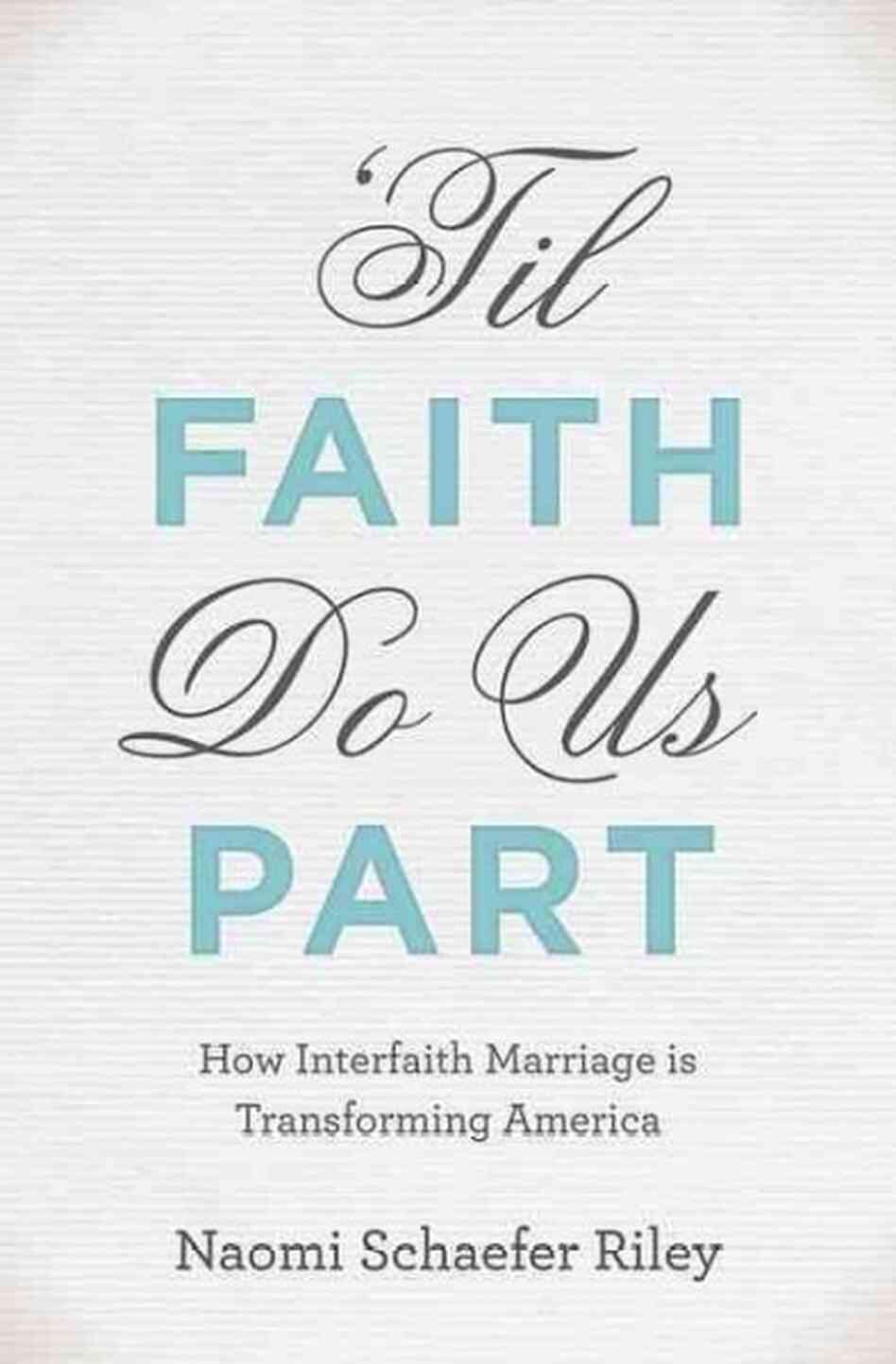
Let's just say, I finished the book in about a day (though I've kept it checked out of the library waaaay past its due date...oops!). Many people might have found the large number of statistics a bit dull, but I devoured most of them, and really want to try to remember as much as possible from this book for use in my studies in Rome and beyond.
I was a bit disheartened by the somewhat negative tone of the much of the book. Now, the (Jewish) author clearly knows that interfaith marriage can succeed--based on her marriage to a man raised as a Jehovah's Witness (who stopped practicing). But her words seem to put a lot of negative spin on the issues, from the very first issues arising about planning the wedding (one clergy member, two, or a justice of the peace?) to choosing the religion of children (one, both, or none?) and death practices. Even the title itself implies that divisiveness is the order of the day in interfaith relationships, rather than compromise and a desire to learn. I certainly do appreciate a lot of what she said: after reading her book, I see that interfaith can clearly pose challenges. Some such marriages end in divorce, or lead to both members moving away from religion, which may result from the marriage specifically or just arise from individual decisions.
But there are so many things to celebrate in an interfaith families, things that are difficult to experience in as real depth in a same-faith family. A living, breathing appreciation of diversity. A deep knowledge of another faith (remember, I was accepted to study at a Catholic University in Rome, for which an advanced knowledge of Catholic theology was required, something helped by knowing about my mother's faith for my whole life). The ability to understand that no one has to be "right" in matters of faith, that we can all be "right" in different ways (which brings to mind the title of a book You Don't Have to be Wrong for Me to be Right, by Brad Hirschfield, a book I have not read but love the title). Here are some of what I though were the most interesting bits:
- "About 20% of couples married before the 1960s were interfaith matches. Of couples married in the past decade, 45 percent were." p. 6
- "One woman I spoke to, who was brought up Catholic, recalls her thoughts on dating when she went off to college: ‘To limit yourself to only people of your own religion seemed bigoted…There is a whole world of people that I don’t know.’ To write them off as potential partners before she even met them ‘seemed rude.’ The language is revealing. It’s as if our society’s institutional rules about hiring an employee or admitting someone to college have morphed into rules for dating.” p. 13
- "We often tend to imagine interfaith weddings as having two officiants—that both the bride and groom’s traditions are represented equally, perhaps symmetrically. The New York Times wedding announcements do seem to mention a disproportionate number. But weddings with religious leaders from different faiths are rare: only 4 percent of interfaith (and, surprisingly, 2 percent of same-faith) couples employ them. Instead, interfaith couples are much more likely to have used a civil official (43 percent vs. 31 percent for same-faith couples).” p. 62
- “Americans are mostly reluctant to raise their children in more than one faith…According to my survey, about 80 percent of same-faith couples raised their kids in one faith and about 20 percent raised them in no faith. A plurality of interfaith couples, about 40 percent, agreed to raise their children in one faith. About a third are raising their kids with no faith; and another 20 percent are trying to raise them in both.” p. 99
So for those who choose to seek a partner in the same faith, is there a legitimate, non-discriminatory-seeming way to limit oneself to members of the same religion? Or should that even be a goal in today's multifaith world?
All of these discussions about interfaith marriages get me thinking about my own views on marriage. One of the biggest issues I see with interfaith marriage is the threat of loneliness when wanting to attend religious services. In our family, we sometimes all go together--to temple, to church. But over the past four years in Virginia, and this summer even at home as I start attending more often, if I want to go to services, I often end up going alone. And it's hard. It's tough to be the only person there under 65. It's sad to be alone when everyone else is sitting there with family. And while many people in congregations are usually welcoming, it's just not the same feeling to attend temple alone, maybe because growing up Jewish meant I had a strong community, where I knew a lot of people at temple, and a lot of people knew me. So would I be willing to do that for the rest of my life, if I were to marry someone who was not Jewish? To maybe spend many Friday nights alone in the synagogue, without my significant other?
I don't have that answer yet. But with all of these statistics and ideas swirling around, and as I leave the disappointing college dating scene behind and head out into the wider world, it will definitely be something I keep in the back of my mind.
Now go out and love one another.
<3,
Allyson
 P.S. Can I just point out, the author of this book spent a few pages detailing how much she dislikes the "kitschy" element of mixed-religion cards/paraphernalia (like a Christmas-Chanukah card). I LOVE THESE TYPES OF THINGS mainly because I LOVE Christmas. Send me a card with Santa spinning a dreidel and we may just be friends forever. Because it's less about a specific statement about religion, and more about celebrating that some families are diverse. They sell cute cards here, for anyone who feels a strong desire to bombard me with interfaith love while I'm in Rome...www.mixedblessing.com
Sunday, July 28, 2013
A Challenge for Everyone
Hello, friends.
Have you been inside a church? What about a synagogue? A mosque? How about a gurdwara (Sikh house of worship)? I recently had lunch with a friend of mine, and we got onto the subject of Jewish people visiting churches. I remember mentioning to a few young Orthodox Jews last summer that I have been to church, and they appeared shocked. But why?

For me, attending church was never a conflict of interest. I pray in a synagogue, I pray in bed, I pray on the street...why can I not pray in a church? Through the years, our family has never been regular attendees of any religious service--we did not go to temple every Friday night, nor church every Sunday morning. But we would go on major holidays, generally to mass on Easter and temple on Yom Kippur. For my part, I would participate in the mass as I felt appropriate: I avoided prayers mentioning Jesus, for example, but happily participated in the more general prayers referring to "G-d." Have you heard of the Our Father prayer? It is a good staple prayer for some Christians, I learned it from a childhood friend who was Christian, and I remember it today and still say it if the occasion arises and I am surrounded by others saying it (at least the first part). Here is a link to the prayer, for those who are not familiar with it: http://www.catholicplanet.com/catholic/our.htm. Saying this prayer--which does not conflict with my conception of Judaism--does not threaten my religious life, but enhances it. I even say prayers written by recent rabbis, they're not necessarily in "official" prayerbooks, but respected men and women wrote them, and I agree with them, so I say them.

Now, apparently visiting a church, for the strictest of Jews, is off-limits. Why? For one thing, Judaism prohibits idolatry. Some Jewish people feel that entering a church, some of which have sculptures of Jesus, or saints, would go against this stricture (though most Christians would reject that the imagery in churches is idolatry, I would imagine because they do not consider these symbols actual gods but instead representative imagery). I imagine it would even be offensive to many Christians if they were aware that some Jewish people consider their practice "idolatrous." But I suspect a lot of those who resist do so more out of discomfort rather than religious rules. Instead, some strict Jews (again, remember: I'm speaking about the most conservative; my liberal Jewish friends and relatives find it shocking when I mention that some Jews won't enter a church) might only enter a church for non-religious purposes: to view an important painting, for example, but will not attend during services. Which would mean missing a Christian's friend wedding if it were to take place in a church. But since I'm obsessed with weddings, that clearly will never be an objections you'll hear from me. All joking aside, for me, G-d knows what is in my thoughts and heart; the location of the prayer matters less to me than the meaning of the words I pray. Here's some more information on the Jewish perspective of the topic: http://www.myjewishlearning.com/ask_the_expert/at/ask-the-expert-jews-church.shtml
I guess I had never realized that some people had never been in a church. I could better understand some of my friends from further south, where temples are scarce, never having entered a synagogue. But especially when speaking with people of other faiths, my comfort level in a church and my awareness of Christian religious services can be very helpful. On the other hand, I have only been to Catholic and Jewish services, so perhaps I overreact in my shock at others' lack of experience in various religious settings. I attended services that my family attended (and only Catholic or Jewish weddings by chance as well...so far).*
But I want to. I want to attend a Muslim mosque.** I want to visit a Quaker meeting house. And a gurdwara. And a ton of other religious houses. Because doing so does not shake my commitment to Judaism--my go-to prayer tends to be the Shema (http://www.jewfaq.org/prayer/shema.htm), regardless of the situation or location. But when I meet someone who believes otherwise than I do, if I know at least a little bit about their religious life, I can meet them on a more even, educated playing field. People choose their religions for a reason, and feel strongly about them for a reason, just as I do about Reform Judaism, and I want to understand peoples' passions. It does not have to threaten my beliefs.
So, regardless of your religion, I challenge you to push it as far as you feel you can and attend some type of alternative religious...something. Maybe go to a church if you've never been or head to a nearby synagogue. See if a local mosque or meeting house will allow outsiders to attend services. If you really feel uncomfortable about this, maybe try attending an event held by another group--for example, a social event at a religious location, and listen to how people discuss their faith. Bring along a friend, drag along a sibling, convince your spouse. Make sure to do a quick Google search before you go to make sure you know of any religious differences--if you attend a synagogue, men should put on a yamulke upon entering, for example (liberal congregations often have a box near the door). But give it a shot--even if you mess up, if you go with an open heart, most people will welcome your interest.
Now go out and love one another.
<3,
Allyson
*I have attended Orthodox Jewish synagogues in Italy, and since women sitting behind a barrier (like an actual fence) during services goes against the very core of my being, I guess that was kind of attending a different type of religious service, not something anyone in my family would attend.
**In all fairness, I wanted to attend with a friend in college one month but was told I would not be so well-received by those praying there...perhaps it was just that congregation, or perhaps it was because more generally visitors are not welcomed in mosques, though I would imagine the former.
Have you been inside a church? What about a synagogue? A mosque? How about a gurdwara (Sikh house of worship)? I recently had lunch with a friend of mine, and we got onto the subject of Jewish people visiting churches. I remember mentioning to a few young Orthodox Jews last summer that I have been to church, and they appeared shocked. But why?

Temple Adas Israel, Sag Harbor--the oldest synagogue on Long Island
For me, attending church was never a conflict of interest. I pray in a synagogue, I pray in bed, I pray on the street...why can I not pray in a church? Through the years, our family has never been regular attendees of any religious service--we did not go to temple every Friday night, nor church every Sunday morning. But we would go on major holidays, generally to mass on Easter and temple on Yom Kippur. For my part, I would participate in the mass as I felt appropriate: I avoided prayers mentioning Jesus, for example, but happily participated in the more general prayers referring to "G-d." Have you heard of the Our Father prayer? It is a good staple prayer for some Christians, I learned it from a childhood friend who was Christian, and I remember it today and still say it if the occasion arises and I am surrounded by others saying it (at least the first part). Here is a link to the prayer, for those who are not familiar with it: http://www.catholicplanet.com/catholic/our.htm. Saying this prayer--which does not conflict with my conception of Judaism--does not threaten my religious life, but enhances it. I even say prayers written by recent rabbis, they're not necessarily in "official" prayerbooks, but respected men and women wrote them, and I agree with them, so I say them.
St. James R.C. Church, Setauket--where we held my grandmother's funeral mass
I guess I had never realized that some people had never been in a church. I could better understand some of my friends from further south, where temples are scarce, never having entered a synagogue. But especially when speaking with people of other faiths, my comfort level in a church and my awareness of Christian religious services can be very helpful. On the other hand, I have only been to Catholic and Jewish services, so perhaps I overreact in my shock at others' lack of experience in various religious settings. I attended services that my family attended (and only Catholic or Jewish weddings by chance as well...so far).*
But I want to. I want to attend a Muslim mosque.** I want to visit a Quaker meeting house. And a gurdwara. And a ton of other religious houses. Because doing so does not shake my commitment to Judaism--my go-to prayer tends to be the Shema (http://www.jewfaq.org/prayer/shema.htm), regardless of the situation or location. But when I meet someone who believes otherwise than I do, if I know at least a little bit about their religious life, I can meet them on a more even, educated playing field. People choose their religions for a reason, and feel strongly about them for a reason, just as I do about Reform Judaism, and I want to understand peoples' passions. It does not have to threaten my beliefs.
So, regardless of your religion, I challenge you to push it as far as you feel you can and attend some type of alternative religious...something. Maybe go to a church if you've never been or head to a nearby synagogue. See if a local mosque or meeting house will allow outsiders to attend services. If you really feel uncomfortable about this, maybe try attending an event held by another group--for example, a social event at a religious location, and listen to how people discuss their faith. Bring along a friend, drag along a sibling, convince your spouse. Make sure to do a quick Google search before you go to make sure you know of any religious differences--if you attend a synagogue, men should put on a yamulke upon entering, for example (liberal congregations often have a box near the door). But give it a shot--even if you mess up, if you go with an open heart, most people will welcome your interest.
Now go out and love one another.
<3,
Allyson
*I have attended Orthodox Jewish synagogues in Italy, and since women sitting behind a barrier (like an actual fence) during services goes against the very core of my being, I guess that was kind of attending a different type of religious service, not something anyone in my family would attend.
**In all fairness, I wanted to attend with a friend in college one month but was told I would not be so well-received by those praying there...perhaps it was just that congregation, or perhaps it was because more generally visitors are not welcomed in mosques, though I would imagine the former.
Sunday, June 30, 2013
Let's Talk About: Gay Marriage
Hello, friends!
Why don't we get a little controversial today, hmm?
I spent a lot of my past few years in college asking questions: "Why do you choose to go to services every week?" "What does your faith say about sex outside of marriage?" "What are your views on gay marriage?" I spent a lot of time "seeking first to understand," as our favorite man Stephen Covey said, before I ever sought to be understood. Okay, to be honest, I did not "seek to be understood" often enough.
Perhaps that was my fault. But I didn't want to make anyone uncomfortable--so I sat there and listened to various friends explain why alcohol was frowned upon in some religious groups, why gay marriage is not okay with them, their views on abortion. Opinions I often disagreed with, sometimes very strongly. I asked, and listened, and learned a lot, and (tried to) mostly keep silent if I disagreed. This blog is by all means not about pushing you to agree with my opinions (unless, of course, I can convince some more people about the importance of interfaith work, but you know what I mean), but in this post I wanted to explore a situation I recently dealt with on an individual level, and it does involve sharing my opinion. Bear with me.
Sitting in my car one night last week, I heard the end of a song on the radio, and I was shocked. It sounded like a hip hop song supporting gay rights. What?! This was on mainstream radio! I was shocked and a little excited, so I shut off my car and ran into the house to start looking for the video, and I found the song, called "Same Love," as in "All love is the same love." Here is the official video:
I am not going to lie: it touched me. To hear a somewhat mainstream artist sing about this, bluntly address a lot of the hate that exists in our society, and try to fight it, meant a lot to me. The video also tells a love story. I'm sure it makes a lot of people uncomfortable because the story involves two men, but if it were about a straight couple of two races for example, living out their lives together, getting married, supporting one another in illness, it would engender an emotional response, maybe even tears from a lot of people. I loved this video.
I decided to post the video as my Facebook status. Several times I put it up, then immediately deleted it. And why? Because some of the messages in the video seem to attack Christianity and conservatives: comments like "We paraphrase a book written 3,500 years ago" and "The right-wing conservatives this it's [being gay] a decision." I am so intent upon trying to not hurt peoples' feelings, that sometimes I let that overcome my desire to share my own opinion, and to share something that really had an impact on me. Clearly, the video makes some gross generalizations--not all Christians oppose gay marriage, and not all conservatives think one can decide upon their sexuality. I am not claiming this song is perfect. But the singer was apparently raised attending church, and so if we look at it from his perspective, he is commenting upon an institution he knows about, for better or for worse.
So I'm not going to hide. I am sorry if anyone was offended by the video, but I am not sorry I posted it. I like to spread the news when something really touches me, as this song and video did, and I was honestly shocked that none of my friends had shared the video earlier (it came out last fall). It's a love story, simple as that.
I'm wondering, though, how we can talk about these controversial issues in ways that people feel like everyone gets an equal say, and no one feels attacked. Because inherent in some conversations about gay marriage with very religious people might be the thought that their opinions are backwards, hateful, unfair. Granted, some are, but I have never met someone who said anything hateful about gay people or anybody (I could not be friends with someone harboring such blind hate in their hearts). My friends often cite passages from the Torah or Bible that lead to their opposition of the practice of same-sex relationships. I do not agree with their viewpoints, but I respect their religious convictions...and I wish they could see some of my side of the argument. I rarely brought them up, though, for fear that my friends would think that I was judging them for their judgment of homosexuals.
But I also am not sure if religious folks fully understand just how hard it is to hear about opposition to gay marriage--imagine if we said something like, "I oppose people being allowed to get married in a church" or "I do not support the right of heterosexuals to get married, let's make it illegal." It goes against the very fiber of my being to deny someone the same rights that I and many other are granted, to get married simply because we happen to like members of the opposite sex, and it's like "Why would my marriage in a church affect you?" And it wouldn't. That's a large part of what makes it hard to hear your opinions, because to some extent, it is very hard for us not to think of it as discrimination, or to understand why we cannot at least offer the freedom. We're not forcing anyone to take advantage of it. But once I've spoken with many of you who do oppose it, I at least understand why you feel that way. That doesn't mean it's not hard to hear it.
Then I have spoken with other, very liberal people who could never imagine being friends with people who oppose gay marriage, and that is not right either, to dismiss someone so completely without even listening to them. It seems black and white, but things rarely are.

I thought that I had spent these past four years having meaningful, interfaith discussions--and I did. But I think there was something missing in them, because I didn't have the courage or chutzpah to speak up, to voice my opinions. It was out of an attempt to keep the peace, but that was at the expense of really having full, well-rounded discussions where everyone had the opportunity to contribute. I forgot about the second part of Stephen Covey's idea: "Seek first to understand, then to be understood." I want to be understood.
In the end, the current debate about gay marriage in our country comes down to one main thing for me: freedom. The main opposition I see today to gay marriage comes from conservative, mainly Christian, religious groups. That is not right. Our country is founded on religious freedom, and guess what? My movement of Judaism strongly supports gay marriage, they have released numerous official comments in this regard. So what this means is that, right now, my religion is in some way being subjected to the opinions of another religion, and that is just blatantly wrong. Allowing freedom for homosexual couples to get married does not need to affect religious people--they can still choose to only marry heterosexual couples, only allow same-sex couples into their groups, exclude homosexuals from participating in their rituals. But by keeping gay marriage banned, our country is preventing those religions that support it from enjoying the full exercise of their religion. G-d willing, with a few more successes like the one we had this past week in the Supreme Court, this imbalance will be rectified. And hopefully our lawmakers can find a way to put many of their religious assumptions aside--from whichever side of the argument they fall on--and make decisions that can really benefit all Americans.
Now go out and love one another.
<3,
Allyson
-------------------------
For more posts, or to join the e-mail list, please head to www.christmasandkreplach.blogspot.com.
Wednesday, June 26, 2013
The Trees Were Red
Hello friends,
I went to visit Dachau Concentration Camp two weeks ago during a
visit to Munich, my first ever visit to a concentration camp, and I wanted to share my impressions here:
All I could see was red.
All I could see was red.
Red on the gravel crunching under my ballet flats. Red
on the tall trees towering above the open fields. Red smeared across the
doorways of religious monuments at one end of the compound. Red everywhere.
Not literally, of course, but the taint of the horrors that happened at Dachau and other camps like it chilled my blood. I happened to visit on a hot, cloudless day. Objectively speaking, the entire place could look lovely--big, open area, two rows of tall, full trees towering over the middle main road of the compound. But it was the little things that really got to me. The entry gates that read "Work will make you free," one of the lies that Nazis thought up to convince people to work harder, or the nondescript sign down a small forest path that read, "Execution Range with Blood Ditch." Birds chirped around me, I stood alone, and saw this stone, almost unnoticed, on a forest path.

To give a brief description of the layout of the camp (Dachau apparently was the model used to design most of the other camps), we walked in through the gates down at the bottom right of the image below and stood in a big open area (3). This was where the prisoners would be lined up and counted, etc. On this end now stands a museum building (5), a monument in several languages, and a black metal memorial sculpture made to look like barbed wire but if you look closely includes images of humans in agony. As you turn to face down the main central road of the camp, flanked on both sides by trees (1), extending out on either side are where the barracks once stood (2). Now, only two have been recreated, but the outlining foundations of the others extend back a long way.

Not literally, of course, but the taint of the horrors that happened at Dachau and other camps like it chilled my blood. I happened to visit on a hot, cloudless day. Objectively speaking, the entire place could look lovely--big, open area, two rows of tall, full trees towering over the middle main road of the compound. But it was the little things that really got to me. The entry gates that read "Work will make you free," one of the lies that Nazis thought up to convince people to work harder, or the nondescript sign down a small forest path that read, "Execution Range with Blood Ditch." Birds chirped around me, I stood alone, and saw this stone, almost unnoticed, on a forest path.

On the ground at Dachau Concentration Camp, outside of Munich, Germany

Layout of Dachau, from http://www.scrapbookpages.com/DachauScrapbook/DachauCampMap.html
At the opposite end (6, 7, 9) are the locations of several memorial locations, like a Jewish building, and Christian buildings from various denominations. All in all, they are pretty stark, to be honest. The horror for me lay in looking out across the enormity of the place and its emptiness. The camp was meant to hold 6,000 (mostly political) prisoners, but when it was liberated in 1945, it had 30,000.

Number 11 is where "Barracks X" aka a gas chamber and crematorium stand. I stood in a gas chamber. I stood in a gas chamber. Red, everything, everything was red in the feeling, in the darkness, in the chill horrors of what the camp was built for. Whether or not the gas chamber was ever used is up for discussion, but the hatred palpable in the design of the building where they stood was horrible. There was a room for prisoners to wait in. Then one for them to strip of all their clothes, and where they were told they were going to take "showers." This led into the gas chamber, complete with fake shower heads to keep prisoners calm. Then the next room was for storing dead bodies. Then the ovens. One room after another, systematic, treating the people like they were not even human, just numbers to be processed through the huge chain of murder.

How could people have done this to one another? This is not only about antisemitism, or religion in general, or color or politics. It's about all of that. It's about how a group of people, yes, led by one madman, but how an entire group of people undertook an operation to try to rid Europe and ultimately the world of "undesirable" types. Yes, this included Jews, and yes, that means the Holocaust (or "Shoah," as Jewish circles often refer to it) holds particular weight for me. Why would someone ever want to kill me, simply because I pray in Hebrew? Or if someone were to abstain from eating pork or doing something on Saturdays? It's hard to comprehend. But the murders extended beyond Jews, too, to the disabled, to Catholics, to the political opposition, to Gypsies, and others.
Which makes interfaith efforts today all the more essential. As I have written before, the old adage of not talking about religion just doesn't hold for me. I have had many tough conversations, sometimes even with friends, when we disagree vehemently on critical issues. Sometimes I honestly wonder if my very religious Christian friends think I am doomed to some bad fate because of my religion. But we talk about the issues. We come to the table acknowledging that we respect one another and our mutual faith choices, and then we talk about it. I'm not advocating walking up to strangers and saying, "Hi, I'm Jewish/Christian/Muslim/etc. Let's chat!" (*ahem* Not that I've ever done that before *ahem*) but if you see an opportunity where maybe you don't understand something someone says about their religion, or maybe someone doesn't seem to understand your views, open the door. I often find asking questions is the best way to explore these topics, by simply saying to someone, "As a religious individual, what is your view on this topic?" with no expectations usually of even discussing my views unless they ask. It can be hard to listen, but also essential.
So remember the horrors of the Holocaust as you go about your day today, tomorrow, this week. Jewish people really focus on the idea of "never forget" with regard to the Holocaust, but I fear that we do. We forget that 12,000,000 died just a few decades ago. Twelve million. We go about our days, myself included, and herald the strides that are being made, that the new Pope came out and supported people of all faiths and even those with no faith, that Muslims in Britain vehemently responded in opposition to the crazy man who killed a solider there just a few weeks ago supposedly because of his mistaken sense of Muslim duty. But the Holocaust was not so long ago, and even today people are persecuted for their beliefs in places around the world.
The number 12,000,000 did not mean as much as it did when I stood in Dachau and realized just how large a camp for 6,000 people was, and it put some things in perspective. I visited the camp as part of a three-week backpacking trip through Europe this month, and many times I visited Jewish sites in the places we went. The museum in Amsterdam. A memorial in Berlin. The Jewish section in Prague. Places devoid of the strong Jewish presence that existed there before the Shoah. Maybe the Nazis did not kill all European Jews, but those Jews that remain are mere shadows of the vibrant communities that once existed there. Perhaps I'm cynical because of all of my research into contemporary antisemitism in Europe, and I am sure that many Jewish individuals happily live in various European nations today, but many times all I can see--in Dachau, in Berlin, everywhere in Europe--is red. Here's to hoping that with the right efforts from people of all faiths, some day that red will no longer symbolize death, but love.
Now go out and love one another.
<3,
Allyson

View from a window in the recreated barracks
Number 11 is where "Barracks X" aka a gas chamber and crematorium stand. I stood in a gas chamber. I stood in a gas chamber. Red, everything, everything was red in the feeling, in the darkness, in the chill horrors of what the camp was built for. Whether or not the gas chamber was ever used is up for discussion, but the hatred palpable in the design of the building where they stood was horrible. There was a room for prisoners to wait in. Then one for them to strip of all their clothes, and where they were told they were going to take "showers." This led into the gas chamber, complete with fake shower heads to keep prisoners calm. Then the next room was for storing dead bodies. Then the ovens. One room after another, systematic, treating the people like they were not even human, just numbers to be processed through the huge chain of murder.

A pile of dead bodies outside the Dachau crematorium
How could people have done this to one another? This is not only about antisemitism, or religion in general, or color or politics. It's about all of that. It's about how a group of people, yes, led by one madman, but how an entire group of people undertook an operation to try to rid Europe and ultimately the world of "undesirable" types. Yes, this included Jews, and yes, that means the Holocaust (or "Shoah," as Jewish circles often refer to it) holds particular weight for me. Why would someone ever want to kill me, simply because I pray in Hebrew? Or if someone were to abstain from eating pork or doing something on Saturdays? It's hard to comprehend. But the murders extended beyond Jews, too, to the disabled, to Catholics, to the political opposition, to Gypsies, and others.
Which makes interfaith efforts today all the more essential. As I have written before, the old adage of not talking about religion just doesn't hold for me. I have had many tough conversations, sometimes even with friends, when we disagree vehemently on critical issues. Sometimes I honestly wonder if my very religious Christian friends think I am doomed to some bad fate because of my religion. But we talk about the issues. We come to the table acknowledging that we respect one another and our mutual faith choices, and then we talk about it. I'm not advocating walking up to strangers and saying, "Hi, I'm Jewish/Christian/Muslim/etc. Let's chat!" (*ahem* Not that I've ever done that before *ahem*) but if you see an opportunity where maybe you don't understand something someone says about their religion, or maybe someone doesn't seem to understand your views, open the door. I often find asking questions is the best way to explore these topics, by simply saying to someone, "As a religious individual, what is your view on this topic?" with no expectations usually of even discussing my views unless they ask. It can be hard to listen, but also essential.
So remember the horrors of the Holocaust as you go about your day today, tomorrow, this week. Jewish people really focus on the idea of "never forget" with regard to the Holocaust, but I fear that we do. We forget that 12,000,000 died just a few decades ago. Twelve million. We go about our days, myself included, and herald the strides that are being made, that the new Pope came out and supported people of all faiths and even those with no faith, that Muslims in Britain vehemently responded in opposition to the crazy man who killed a solider there just a few weeks ago supposedly because of his mistaken sense of Muslim duty. But the Holocaust was not so long ago, and even today people are persecuted for their beliefs in places around the world.
The number 12,000,000 did not mean as much as it did when I stood in Dachau and realized just how large a camp for 6,000 people was, and it put some things in perspective. I visited the camp as part of a three-week backpacking trip through Europe this month, and many times I visited Jewish sites in the places we went. The museum in Amsterdam. A memorial in Berlin. The Jewish section in Prague. Places devoid of the strong Jewish presence that existed there before the Shoah. Maybe the Nazis did not kill all European Jews, but those Jews that remain are mere shadows of the vibrant communities that once existed there. Perhaps I'm cynical because of all of my research into contemporary antisemitism in Europe, and I am sure that many Jewish individuals happily live in various European nations today, but many times all I can see--in Dachau, in Berlin, everywhere in Europe--is red. Here's to hoping that with the right efforts from people of all faiths, some day that red will no longer symbolize death, but love.
Now go out and love one another.
<3,
Allyson
Tuesday, June 4, 2013
Going to the __________ and we're gonna get married
Hello, friends.
I'm 22. When did that happen? (Actually, it happened on February 8. I may be terrible at remembering names, but I do know my birthday!) Most of my friends are vaguely the same age: 21, 23, etc. In many cultures around the world, by this age my friends and I would already be married with multiple children.
This trend is not limited only to people in far-off places, though, places like rural Africa or islands in a distant sea. Marrying young is a trend for many traditional religious folks even in the US, whether they are amongst my friends in the Modern Orthodox community in NYC or my traditionalist Christian friends from further south. Is it for the best, though?
Some of my secular friends can't even contemplate marriage yet. "We just graduated college, for goodness' sake! Marriage?! We barely even know what to do with the next year of our lives, let alone the rest of our lives!" seems to be the feeling in that group. Then some of my more religious friends are much more certain of their desire to get married. I can comfortably discuss their desires to marry and have children, probably not immediately, but at some point in the next few years. Certainly there are some people who fall on the opposite sides (religious people who are definitely not comfortable thinking about marriage right now, and secular people who know they want to get married) but my experience thus far has shown that those with a stronger faith life are more firm and open in their desire to get married.
I think it has to do with religious community norms. Amongst Christian groups getting married is often pushed, as in Jewish communities. From early on, discussions in religious groups, religious schools, etc. often focus upon marriage and children, and what the particular religion views as the proper home life. Celibacy until marriage for strict Catholics, for example, or marrying another Jew for many Jews. I remember having a full-fledged mock wedding in Hebrew School when we were maybe 10, complete with wine and a chupah (pronounced with a "ch" like in "challah," chuh-paa, a traditional Jewish wedding canopy).
But secular folks might be missing similar opportunities to openly discuss these ideas, unless their parents decide to discuss it regularly for some reason. Let's look at TV shows as an example of a small view of secular culture. In these, the secular culture presents a lot of sex outside of marriage in its twenty-something sitcoms (thinking of "Friends" and "How I Met Your Mother," both shows I love but they do have a lot of sex in them). Then you have the middle-age sitcoms that present the kind of ideal mid-life situation: married with kids, thinking back on crazier younger days, but with stable family lives (like "Everybody Loves Raymond" or "Modern Family"). But do we present enough of a clear, perhaps less sex-crazed route for non-religious young people? Because I just don't love this view in the media, through shows like these where people appear to have sex with a bunch of people throughout their twenties, until they finally find someone they like enough to marry in their thirties. My personal views on the matter completely aside, I think there has to be an alternative other than this rampant sex model or more conservative interactions until marriage. Can't we have some balance? I wonder if this type of sex-driven relationship model (and for more info, check out any of the many articles published in the last few years about "hook-up" culture) is one of the reasons behind some failed marriages today, as religious groups also tend to frown upon divorce and thus also have a higher marriage success rate.
Maybe some secular people also feel a bit awkward like I do, talking so openly about marriage and how we want to get married, almost as though by saying "I want to get married" implies either that I do not fulfilled with just myself, or that I am confident that someone will actually want to marry me. It's different for religious communities in which everyone plans to get married, but in secular culture, I understand that it can be a little awkward to discuss.
Then there's the whole complication of whether or not people want to have children! In religious communities, again, having children is usually seen as a mitzvah (a good deed). But for some secular people (again, I am not claiming this as my opinion), without the cultural and religious norm of propagating life as being an ideal situation, they might ask why they would have children. "Interrupt my life and career, for what?" Same thing with sex in general: without a religious reason to abstain, why would people do so? I am sure there are many in the middle, but for some reason it often seems like a there exists a sharp divide between the very religious opinion of relationships, and the sexual one presented in the media.
How can we present a healthy view of romantic relationships in both religious and secular culture? Can there be a middle point between the two? Is marrying young a better option than marrying later, or vice versa? How can we teach our young men and women to have healthy partnerships in life that both fulfill their needs and still maintain respect for themselves and others? I think this is not only a religious issue, but also a cultural one. What does your religion teach about this?
Now go out and love one another.
<3,
Allyson
Subscribe to:
Posts (Atom)
Interfaith and the Environment: Quoted in a Zoroastrian Publication
Hello, friends. Last August, I attended the Parliament of the World's Religions in Chicago and was excited to present on a few panels wi...

-
 Hello, friends! For those who have not yet seen it, I wanted to share a post I wrote that was recently published on the Union for Reform J...
-
Hello, friends. " It’s a disgusting thing to call someone. Dirty blood, see. Common blood. It’s ridiculous. " --Ron Weasley, ...
-
Hello, friends. As many of you might have guessed, this post has been spurred by the recent announcement that the current pope, the leader...


